
Steel
Nominal pipe size vs. actual diameter
The short answer
Nominal pipe size is a name, not the measured outside or inside diameter. ASTM A53/A53M-24, Note 1, says the dimensionless designators NPS (nominal pipe size) and DN (diameter nominal) replaced older terms such as “nominal diameter,” “size,” and “nominal size.” Note 2 says “nominal wall thickness” is a convenient name and is distinct from the actual wall, which may be over or under the nominal wall.
ASME B36.10M-2018 standardizes pipe dimensions and says pipe NPS 12 (DN 300) and smaller has outside diameters numerically larger than the corresponding sizes. Schedule is a wall-thickness series in that standard’s contents. It is not, by itself, a pressure rating. The dimension table is copyrighted and is not reprinted here. Use the ASME standard when you need the published sizes and weights.
This is an educational example. It does not rate a pipe for pressure, and it does not replace the ASTM or ASME standard named in the purchase order. A piping engineer determines pressure design under the code the contract adopts.
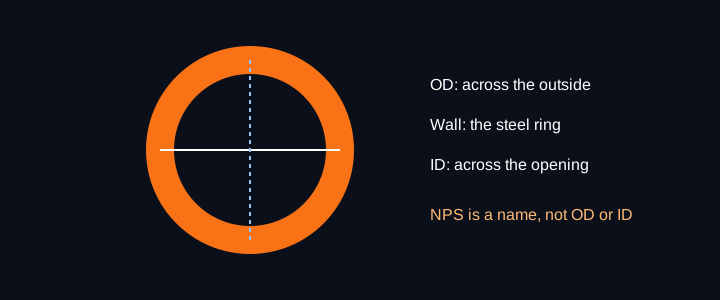
The words on a pipe description
NPS is the inch-pound name. DN is the metric name for that same designation, not a measurement in millimetres of the steel. A 1993 U.S. Department of Veterans Affairs metric bulletin lists NPS 2 opposite DN 50, and NPS 12 opposite DN 300, as names. ASME’s product page likewise pairs NPS 12 with DN 300. The VA bulletin’s rough description of a 2-inch pipe as “about” 2-1/8 in. inside and 2-5/8 in. outside is not used below, because those rounded phrases are not the measured values in the example.
Outside diameter is the distance across the outside of the steel. Inside diameter is the distance across the opening. Wall thickness is the steel between them. For a circular pipe, inside diameter equals outside diameter minus two times the wall only when both the outside diameter and the wall are the values you intend to use. A nominal wall is not a promise of the measured wall. ASTM A53 Note 2 says the actual wall may vary over or under nominal.
ASME B31.3 is a process-piping code. Its product page says it covers materials, components, design, fabrication, assembly, erection, examination, inspection, and testing of piping for fluids that include chemicals, petroleum products, gas, steam, air, water, refrigerants, and cryogenic fluids. A schedule number does not state the allowable pressure in that code. Pressure design depends on the code, the material, the temperature, and the wall the design uses.
How to read one published description
A U.S. Department of Energy technical paper, posted by OSTI, describes purchased 2-inch ASTM A106 Grade B seamless carbon-steel pipes. It states a nominal diameter (OD) of 2.375 inches and nominal walls of 0.154, 0.218, and 0.344 inches, which the paper says correspond to Schedule 40, Schedule 80, and Schedule 160. The example below uses only the 2.375 in. outside diameter and the 0.154 in. wall. The other two walls are left in the paper rather than turned into a schedule table.
- Trade name in the paper
- 2-inch pipe
- Specification in the paper
- ASTM A106 Grade B
- Stated outside diameter
- 2.375 in
- Stated nominal wall
- 0.154 in, called SCH-40
- Calculated inside diameter
- 2.067 in
- Theoretical steel weight
- 3.66 lb/ft
The inside diameter is calculated here as 2.375 − (2 × 0.154) = 2.067 in. The paper does not print that inside diameter, so do not treat 2.067 in. as a published table value. The theoretical weight uses the steel area of a round hollow section and 490 lb/ft³. It is an estimate of steel quantity, not the plain-end weight published in ASME B36.10, and it is not a pressure rating. 3.66 lb/ft is that estimate rounded to 0.01 lb/ft.
Read the description in this order: specification and grade, NPS or DN name, stated outside diameter, stated wall or schedule, and then any measured wall. If the purchase order says only “2-inch Schedule 40,” ask which dimension standard and which material specification apply. Do not invent the missing outside diameter from the numeral 2.
Common mistakes
Adding the schedule number to the nominal size and calling the result a pressure class. The OSTI paper uses Schedule 40 as the name of a 0.154 in. wall on that 2.375 in. pipe. It does not give an allowable pressure.
Using DN 50 as if the outside diameter were 50 mm. DN 50 is the metric designation paired with NPS 2 in the VA naming list. The outside diameter in the worked example is 2.375 in., which is 60.325 mm if converted by 25.4 mm per inch. Those are different numbers on purpose.
Copying a full ASME schedule into a quote. Link the purchase to ASME B36.10 instead of reproducing the table.
What still has to be checked
The piping specification states the dimension standard, the material specification, and the code used for pressure design. ASME has also listed later B36.10 editions, including a 2022 contents page and a 2026 product page, so the edition named in the contract controls. This session verified the pipe-versus-size sentence on the B36.10M-2018 product page, not every later table.
Numeravo has no pipe-volume, pipe-weight, or length-conversion calculator. The pipe, tube, and HSS guide explains why a matching dimension is not a matching specification.
Related tools and guides
References
ASTM International
ASTM A53/A53M, Pipe, Steel, Black and Hot-Dipped, Zinc-Coated, Welded and Seamless
Edition: A53/A53M-24
Section: Scope 1.1, Note 1, and Note 2
Supports: NPS and DN are dimensionless names, and nominal wall thickness is distinct from actual wall thickness.
Checked: November 15, 2026
Open sourceASME
B36.10M, Welded and Seamless Wrought Steel Pipe
Edition: B36.10M-2018 product page; later editions are also listed by ASME
Section: Product-page scope; dimension table not reproduced
Supports: NPS 12 (DN 300) and smaller pipe has outside diameters numerically larger than the size number. The authorized dimension and weight table stays in the standard.
Checked: November 15, 2026
Open sourceASME
B31.3, Process Piping
Edition: Product page current at the time of checking; edition not separately numbered in the fetched summary
Section: Product-page scope
Supports: Process-piping design, materials, fabrication, examination, and testing are a code question, separate from a schedule name.
Checked: November 15, 2026
Open sourceU.S. Department of Energy, Office of Scientific and Technical Information
OSTI record of purchased 2-inch ASTM A106 Grade B pipe
Edition: Paper identified on the PDF as PVP2024-123471
Section: Section 3.1, carbon steel pipes
Supports: One published description: 2-inch pipe, 2.375 in. outside diameter, and nominal walls of 0.154, 0.218, and 0.344 in. described as Schedules 40, 80, and 160.
Checked: November 15, 2026
Open sourceU.S. Department of Veterans Affairs
Metric Design Guide newsletter, pipe names
Edition: Volume 2, Issue 5, September–October 1993
Section: NPS and DN naming list
Supports: NPS 2 is paired with DN 50, and NPS 12 with DN 300, as designation names rather than measured diameters.
Checked: November 15, 2026
Open sourcePractical questions and answers
Can a similar outside size establish interchangeability?
Compare the full product specification, grade, dimensions, tolerances, and project requirements before proposing a substitution.
Which edition belongs with the reference?
Keep the edition required by the applicable project documents with the value. A newer publication does not by itself change that project requirement.
Related calculators
Use these tools for the measurement tasks described below. Verify the product designation and project requirements before applying a converted value.
- Length Converter →
Convert measured lengths between fractional inches, feet, and metric units.
- Volume Converter →
Convert a known volume between cubic feet, cubic yards, liters, and other supported units.