
Steel
Pipe vs. tube vs. HSS
The short answer
A similar diameter or wall does not make steel pipe, mechanical tube, and structural HSS the same product. ASME B36.10M-2018 uses “pipe” for tubular products of the dimensions commonly used for pipeline and piping systems, and it says pipe NPS 12 (DN 300) and smaller has an outside diameter numerically larger than the size number. It says the outside diameters of tubes are numerically identical to the size number for all sizes.
AISC’s HSS FAQ says round HSS is intended for structural members and is usually ordered to ASTM A500/A500M Grade C, while steel pipe in the AISC Manual is made to ASTM A53/A53M Grade B. The same FAQ says an HSS6.625×0.280 has the same dimensional properties as a Pipe 6 Std., and that the two are still designated and specified differently.
This page is an educational reading guide. It is not a substitution list, a structural design, or a purchasing specification. Confirm the product standard, grade, and tolerances with the contract documents and the supplier before ordering or substituting.
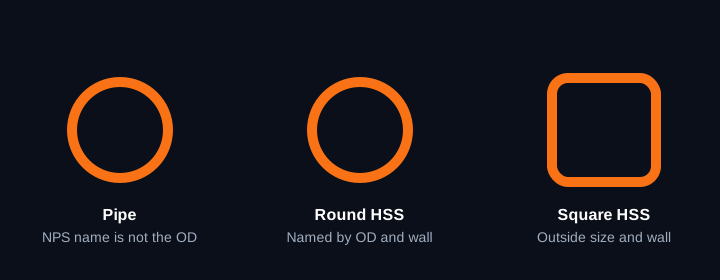
What each name is describing
ASTM A53/A53M-24 covers seamless and welded black and hot-dipped galvanized steel pipe from NPS 1/8 to NPS 26 [DN 6 to DN 650]. Note 1 of that scope says NPS and DN are dimensionless designators substituted for older words such as “nominal diameter” and “size.” The specification says this pipe is intended for mechanical and pressure applications and is also acceptable for ordinary uses in steam, water, gas, and air lines.
ASTM A500/A500M-23 covers cold-formed welded and seamless carbon-steel structural tubing in round, square, rectangular, or special shapes for bridges, buildings, and general structural purposes. Its scope 1.2 limits that tubing to a periphery of 88 in. [2235 mm] or less and a specified wall of 1.000 in. [25.4 mm] or less. Note 1 says products made to A500 may not suit dynamically loaded welded members where low-temperature notch toughness matters, and it points readers toward other ASTM standards that include Charpy requirements.
ASTM A1085/A1085M-22 covers cold-formed welded carbon-steel hollow structural sections for welded or bolted construction. The listed applications include buildings, bridges, towers, cranes, sign supports and poles, offshore platforms, and other structural uses. Scope 1.2 limits production to a periphery of 88 in. [2235 mm] or less and a specified nominal wall of 0.148 in. [3.8 mm] or greater and 1.000 in. [25.4 mm] or less. The same page’s abstract says “not more than 0.875 in.” That abstract does not match scope 1.2. Use the specification text, not the store abstract, when the wall limit matters.
AISC’s FAQ says square and rectangular HSS are designated by outside dimensions and wall thickness as fractions, for example HSS8×8×3/8 or HSS5×3×3/8. Round HSS is designated by outside diameter and wall to three decimals, for example HSS5.563×0.258. The same answer says “TS” and “HSS” are not different structural products: the Steel Tube Institute changed the designation from tube to HSS in 1997.
A comparison you can use while reading a quote
| Product | What the name states | What a matching number does not prove |
|---|---|---|
| Steel pipe | A nominal size, a schedule or weight class, and a pipe specification such as ASTM A53. | That the outside diameter equals the nominal size, or that the piece meets a structural HSS specification. |
| Round HSS | Outside diameter and wall thickness, plus a structural specification such as ASTM A500 or A1085. | That it is the pipe called out for a pressure or mechanical line. |
| Square or rectangular HSS | The two outside dimensions and the wall thickness. | That it can replace round pipe of a similar width, or that the corners are square. |
| Tube, in the ASME B36.10 wording | A size number that ASME says is numerically the same as the outside diameter. | That every supplier using the word “tube” is selling structural HSS. |
Worked example: two descriptions, one pair of dimensions
This example uses designations published in the AISC HSS FAQ. It is a reading example, not a product you can order from this page.
AISC says “Pipe 5 Std.” denotes a pipe with a 5.563 in. outside diameter and a 0.258 in. wall, in the standard-weight series. The same FAQ says round HSS is designated HSS5.563×0.258 for that outside diameter and wall. It also says steel pipe in the Manual is ASTM A53 Grade B with Fy = 35 ksi, and round HSS is usually ASTM A500 Grade C with Fy = 50 ksi.
Those two Fy values are the FAQ’s statements about the usual material, not a test report for a piece in your yard. AISC also says ASTM A53 requires the pipe to be reasonably straight and specifically allows dents up to the lesser of 10 percent of the diameter or 1/4 in., while ASTM A500 places a specific straightness tolerance. Read the cited product specification for the exact tolerance text before you accept or reject a piece.
The reading rule is the point of the example. HSS6.625×0.280 and Pipe 6 Std. can share dimensional properties, as the FAQ states, and still be different specifications. Do not substitute one for the other because the diameter and wall match.
Common mistakes
Treating NPS as the outside diameter. For the pipe sizes ASME B36.10M-2018 describes as NPS 12 and smaller, the outside diameter is numerically larger than the nominal size.
Ordering “tube” and expecting HSS. ASME uses “tube” for a dimensional idea. AISC uses HSS for structural sections made to ASTM A500 or A1085. A supplier’s word “tube” still needs the ASTM designation.
Assuming a square HSS of a similar width can replace a round pipe. The shapes are different, the designation systems are different, and the corner is rounded. The AISC/STI HSS flyer shows an outside corner radius less than three times the nominal wall for the ASTM A500-10 Grade B column in that comparison.
What still has to be checked
The engineer of record, or the specification the engineer cites, decides whether a member is pipe or HSS. The supplier’s mill test report shows the specification and grade that were actually furnished. This page does not list every pipe or HSS size. ASME B36.10’s dimension table and the AISC Manual’s shape tables stay with those publishers.
Numeravo does not have a pipe, tube, or HSS weight calculator. The nominal pipe size guide continues the diameter question, and the steel weight guide explains a bar-weight estimate without turning it into an HSS weight.
Related tools and guides
Read a nominal pipe size
Separate the NPS name, the measured outside diameter, the wall, and the schedule.
Estimate steel weight per foot
See a checked bar example and why a rectangular HSS is not calculated as a sharp box.
Estimate rebar weight
Use the rebar weight calculator for reinforcing bar. It does not publish pipe or HSS weights.
References
ASME
B36.10M, Welded and Seamless Wrought Steel Pipe
Edition: B36.10M-2018, as shown on the ASME product page
Section: Product-page scope statement distinguishing pipe and tube
Supports: Pipe versus tube wording, and the statement that NPS 12 and smaller pipe has an outside diameter numerically larger than the size.
Checked: November 15, 2026
Open sourceASTM International
ASTM A53/A53M, Standard Specification for Pipe, Steel, Black and Hot-Dipped, Zinc-Coated, Welded and Seamless
Edition: A53/A53M-24
Section: Scope 1.1, Note 1, and the stated mechanical and pressure application
Supports: NPS and DN are dimensionless designators, and the stated size range and application of A53 pipe.
Checked: November 15, 2026
Open sourceASTM International
ASTM A500/A500M, Cold-Formed Welded and Seamless Carbon Steel Structural Tubing in Rounds and Shapes
Edition: A500/A500M-23
Section: Scope 1.1, 1.2, and Note 1
Supports: Structural-tubing scope, periphery and wall limits, and the notch-toughness caution.
Checked: November 15, 2026
Open sourceASTM International
ASTM A1085/A1085M, Cold-Formed Welded Carbon Steel Hollow Structural Sections (HSS)
Edition: A1085/A1085M-22
Section: Scope 1.1 and 1.2
Supports: HSS product scope and the nominal-wall range stated in the specification scope.
Checked: November 15, 2026
Open sourceAISC
Steel Solutions Center, HSS FAQ
Edition: Web FAQ, no revision date shown on the page
Section: FAQ 1.3.4, 1.4.6, 1.4.7, and 1.4.8
Supports: Pipe versus round HSS designations, the Pipe 5 Std. and HSS dimension examples, stated Fy values, and the TS-to-HSS name change.
Checked: November 15, 2026
Open sourceAISC and the Steel Tube Institute
HSS flyer comparing ASTM A500-10 Grade B with the newer HSS specification
Edition: Flyer describing a second-quarter 2013 specification
Section: Corner-radius row for rectangular and square HSS
Supports: The flyer’s statement that the A500 column in that comparison has an outside corner radius less than three times the nominal wall.
Checked: November 15, 2026
Open sourcePractical questions and answers
Can a similar outside size establish interchangeability?
Compare the full product specification, grade, dimensions, tolerances, and project requirements before proposing a substitution.
Which edition belongs with the reference?
Keep the edition required by the applicable project documents with the value. A newer publication does not by itself change that project requirement.
Related calculators
Use these tools for the measurement tasks described below. Verify the product designation and project requirements before applying a converted value.
- Length Converter →
Convert measured lengths between fractional inches, feet, and metric units.